Showing posts with label Dental Implant Specialist. Show all posts

Wednesday, October 17, 2018

Sinus augmentation procedures help patients reclaim their smile and oral health with dental implants


A sinus augmentation graft procedure makes it possible for many patients to have dental implants when years ago there was no other option besides wearing loose dentures.
An indirect sinus lift is less invasive than a direct sinus augmentation lift and is performed by preparing the bone for the dental implant as normal. Once the floor of the sinus has been reached, bone is gently packed in the preparation and pressed upward. This motion will tent the membrane of the sinus upward and create additional room for the full length of the implant. Care will be taken not to damage the sinus and this procedure will have no effect on sinus pressure or affect people that suffer from seasonal allergies.

Britten Periodontics & Implant Dentistry is a periodontal practice offering patients personalized dental care in implant dentistry in Clearwater, Florida. Dr. Todd Britten received his Bachelor of Science & Doctorate of Dental Surgery from University of Florida, a Master’s Degree and Certificate in Periodontology and Implant Dentistry; and completed extensive training at the Institute of Advanced Laser Dentistry. He is one of the only board-certified periodontists in Pinellas County. He is a member of the American Academy of Periodontology, American Dental Association, Florida Association of Periodontists, Upper Pinellas County Dental Association, Hillsborough County Dental Association, Hillsborough County Dental Research Association and Florida West Coast Dental Association.

To learn more about Dr. Britten and his dental services, call us (727) 586-2681. For more information about sinus augmentation from the American Academy of Periodontics visit https://www.perio.org/consumer/sinus-augmentation.

Indirect sinus lift Video:
https://youtu.be/hFwGzeMCiLI


Wednesday, November 8, 2017

Ridge Augmentation and Preservation Procedures in Clearwater, FL

Careful management of extraction sockets after a tooth is removed prevents unsightly bone loss and provides a better cosmetic outcome for tooth replacement. To increase the possibility of future implant placement, and to prevent more bone resorption, a ridge preservation procedure may be recommended. Without the use of a bone graft and collagen barrier at the time of extraction, studies show that 30­-40% of the jaw bone is immediately lost. This is because your body perceives that once the root is removed, the bone is no longer needed and your body absorbs or removes it, creating a ridge deformity.
These ridge deformities leave you with inadequate bone and tissue thickness for either bridge or dental implant restoration. The defects may have been caused by trauma, developmental defects, periodontal disease, the wearing of dentures, or through previous tooth loss.

Ridge augmentation procedures have been shown to greatly enhance the cleansability and appearance of your restorations. They increase your chance for long ­term successful dental restoration, both esthetically and functionally. Ridge augmentation procedures may be performed with gum tissue and/or bone grafting materials.

www.brittenperio.com
727-586-2681


Monday, November 6, 2017

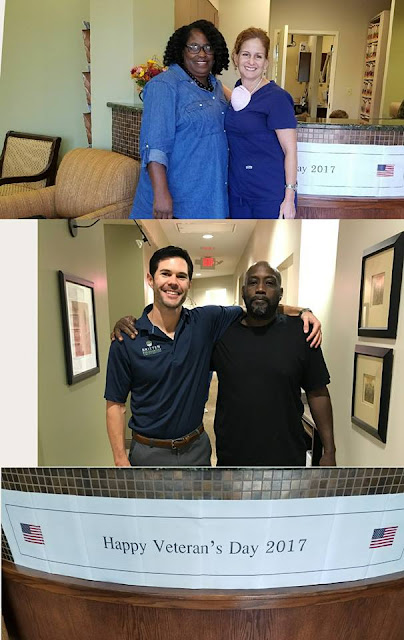
Clearwater FL Periodontist Holds 3rd Annual Veteran's Day Event

Dr. Todd M. Britten and the team at Britten Periodontics & Implant Dentistry had an early start on Veteran's Day which is Friday, November 11th. They held their 3rd annual Free Dental Day for Veterans on Friday, November 3rd, 2017. Britten Periodontics once again had overwhelming offers to help from many dental professionals in the community willing to donate their time and resources to provide free dental care. Patients were directed to the event this year from The Homeless Emergency Project in Clearwater, as well as local V.A. Branches from Pinellas, Pasco and Hillsborough counties.
“Once again, we have had an incredible response from the community and were able to get skilled and compassione local restorative dentists involved.” For the third year in a row, Clearwater Dental Associates, Dr. Jim Hayslett and Dr. Keith Kiskadden and their staff are on board to help out with our event, seeing patients for fillings, crowns and even dentures. New to this year’s event, Dr. Michael Podlusky in Seminole, Florida, also reached out to Dr. Britten to also help, making upper and lower dentures at no-cost for one of the patients. "Many thanks to Dr. Britten for organizing the Veteran's Day Event and graciously offering me the opportunity to help treat a patient. So glad to help at least one of our honored Vets. One person can't do everything, but all of us working together surely can!" Said Dr. Mike Podlusky.   


Dr. Britten’s dental specialty, periodontics, often involves managing and treating advanced gum disease. A periodontist is often able to help a patient in danger of losing teeth or with active oral infection to turn their health around. “Having Clearwater Dental Associates involved again this year, and the gracious help of Dr. Mike Podlusky and his team enables us to provide more comprehensive care to our veterans. Being a periodontist, my specialty is really the surrounding structures of the teeth; roots, gum and bone. My job is to help with the foundation. Having the restorative specialists involved helps us to treat the whole mouth and really deliver comprehensive care to these veterans.” Dr. Britten sees most patients for a comprehensive evaluation, radiographs and treatment consult prior to the event in order to determine what services he as the gum specialist can provide in his office, and make appropriate referral for restorative care from local dentists who have volunteered to help with the event.
Britten says being able to offer two different forms of sedation to Veterans for this event in his Clearwater, FL practice has helped for patients who have PTSD, dental anxiety, or may require extensive surgical treatment.  Dr. Britten expressed his concern. “Most of the time, periodontal disease is not painful until it gets to be very advanced. Some of the veterans had been dealing with painful teeth for a long time.”
For Britten and his team this event is something they look forward to all year long. They keep in touch with veterans from previous events and this year they were able to provide follow up exams, x-rays and periodontal maintenance procedures, which help prevent reinfection of the gums following treatment. “This year we were able to invite Veterans from previous events to receive follow up maintenance care at this year’s event,” said one dental hygienist at Britten Periodontics who helped organize this year’s event. "It was great to see them again and the progress they have made in their oral health. It is touching to be a part of something that has changed someone's life in such a positive way."
One patient returning this year received treatment at the inaugural event was John Smith, who served in the US Navy in Vietnam from 1965-1969. Dr. Britten explained that he was honored to be able to help Mr. Smith and to continue in his care since the 2015 event. The VFW Post 2473 in Clearwater where Mr. Smith serves as canteen manager does much to help local veterans.
When asked what this event meant to him in 2015, Smith had stated, "I get to keep my teeth and I can't believe it's free." A patient new to this year's event, Yvette said, "This was the most amazing dental cleaning I have had in my whole life!"
Dr. Todd Britten explained how glad he is to be doing this the third year in a row and would like to do it annually for the entirety of his career. When asked why this is a cause so near and dear to his heart he stated that his grandfathers and uncles served in the military and giving back to veterans in need is a top priority for him. Dr. Britten said, “The entire staff at Britten Periodontics is so grateful to the men and women in the military that make so many sacrifices for our freedom.”

Britten Periodontics & Implant Dentistry is a periodontal practice offering patients personalized dental care in implant dentistry in Clearwater, Florida. Dr. Todd Britten received his Bachelor of Science & Doctorate of Dental Surgery from University of Florida, a Master’s Degree and Certificate in Periodontology and Implant Dentistry; and completed extensive training at the Institute of Advanced Laser Dentistry. He is one of the only board-certified periodontists in Pinellas County. He is a member of the American Academy of Periodontology, American Dental Association, Florida Association of Periodontists, Upper Pinellas County Dental Association, Hillsborough County Dental Association, Hillsborough County Dental Research Association and Florida West Coast Dental Association.

www.brittenperio.com


Tuesday, October 10, 2017

This is How to Prevent Re-Infection of Your Gums Around Dental Implants

Clearwater Periodontist Dr. Todd Britten Shares:

This is How to Prevent Re-Infection of Your Gums Around Dental Implants


Just like natural teeth there is no guarantee a person’s dental implant(s) will last a lifetime. Although they may look bionic in pictures, a dental implant still needs careful monitoring and regular care. True, they cannot decay like natural teeth – but they are subject to the same complications of gum disease and bone loss. Once a dental implant is placed, treatment does not stop there. If it does, there's a high chance of a re-infection of the gums, even around implants.

If you've undergone treatment for periodontal (gum) disease, you know how involved it can be. If you have lost teeth to periodontal disease and have had dental implants placed, you know the great investment in time and money it takes. Naturally, you would like to protect your investment and keep your dental implant(s) for many years, if not for life!

Periodontal maintenance (PM) is important for all patients after treatment, especially those with dental implants. Plaque, a thin film of bacteria and food particles responsible gum disease, continue to grow again on your tooth and/or implant surfaces as it did before. Diligent, daily brushing and flossing will help to curb that development.
It is also important to keep up regular dental visits for advanced cleaning to remove hard to reach plaque and calculus. Patients prone to gum disease are usually prescribed three or four but for some other gum disease patients, six times a year, especially just after treatment. Many patients alternate visits for periodontal maintenance between a periodontal or implant specialist and their general dentist so that their periodontal condition is closely monitored, as well as the health of their teeth.

Our goal is to reduce the chances of re-infection of the gums, especially around a dental implant. To do this, we'll thoroughly examine your teeth, gums and any implants for signs of disease (as well as an oral cancer screening). This includes an assessment the health of your teeth and gums and to see how well you're doing with plaque control and review your recommended customized daily oral hygiene instructions.

Overall, we want to prevent the occurrence of any future disease and treat it as soon as possible if it relapses. Keeping up with homemade and a routine periodontal maintenance schedule will help ensure your gums, and your implants continue to stay healthy.

If you would like more information on periodontal disease, please contact us or schedule an appointment for a consultation 727-586-2681 or visit www.brittenperio.com

Monday, October 9, 2017

Clearwater Periodontist Shares What You Need to Know About Chronic Dry Mouth


Have you ever noticed bad breath due to dry mouth?

Do you experience pain or discomfort from dry mouth?

Have you had changes in your oral health - like sudden decay or worsened gum disease?

Do you get sores in your mouth or on your tongue frequently?

Does your dry mouth interfere with your sleep?

Do you avoid certain foods because they are too difficult to eat with dry mouth?

Do you have trouble swallowing due to thick mucus?

If you answered "yes" to one or more of these questions, be sure to ask your dentist about dry mouth.  Chronic dry mouth is a condition that can be painful, or even unnoticed by a patient sometimes because they have gotten used to living with the discomfort or incovenience of choronic dry mouth.  It can occur due to medicine, medical conditions, or even lifestyle choices.  It can lead to significant oral health issues like cavities, gingivitis, periodontitis, or problems eating or wearing dentures.

 We have also found in our practice that different remedies help different patients combat chronic dry mouth. Here are some possible suggestions and options for patients with dry mouth:

1. Some patients find comfort from carrying water with them throughout the day and taking small sips.  Cold water may help soothe and calm fiery red tissues. For those without high blood pressure or an adversion to sodium, you can mix a pinch of baking soda in their water and swish and spit this mixture out throughout the day. Baking soda is alkalizing and can protect from decay.

2. A combination of over the counter Biotene products (gels, rinses, sprays, lozenges) used 5 times a day (A combination and routine of these products can usually be recommended by your dental health professional).  Many patients find Biotene Gel to be extremely comforting to their dry oral tissues, especially before bed time.  Patients using C-Pap appliances should use an oral gel as these devices often blow air which aggravates this condition greatly.

3. There is a product available via prescription called Neutrasal. Neutrasal works like saliva to help restore a healthy mouth. A powder pack is mixed and dissolved in one ounce of water, and swished for 1 minute before spitting.  It can be used 2 to 10 times a day, depending on what your dental health care provider recommends, and you should avoid eating or drinking for at least 15 minutes after use.

4. PerioSciences' Anti-Oxidant Gel can also be helpful for our patients suffering from dry mouth.

5. Many patients with dry mouth should be on a strict caries prevention program, which can include prescription toothpaste, rinse, gel, trays, or in-office treatments.  Calcium and phosphate are often included in some of these products, which are minerals that help rebuild weakened enamel.

For more information, call us today at 727-586-2681 or visit our website at www.brittenperio.com

Dr. Britten, your dentist, or dental hygienist will review the cause of dry mouth, as well as your risks for periodontal disease or tooth decay.

Talk to your dentist about your dry mouth symptoms to see which dry mouth treatment is best for you!


Tuesday, July 25, 2017

Clearwater FL Periodontist Dr. Todd Britten discusses importance of Periodontal Maintenance


If you've undergone treatment for periodontal (gum) disease, you know how involved it can be, whether your treatment required nonsurgical therapy, surgical therapy or a combination of both.

Following gum surgery or scaling and root planing, a nonsurgical periodontal therapy, plaque and calculus (hardened plaque deposits) are removed and as they heal swollen, red gums finally begin to regain their healthy pink color.

Treatment does not stop there. If it does, there's a high chance of a re-infection of the gums.

Periodontal maintenance (PM) is important for gum disease patients after treatment. Plaque, a thin film of bacteria and food particles responsible gum disease, continue to grow again on your tooth surfaces as it did before. Diligent, daily brushing and flossing to curb that development.

It is also important to keep up regular dental visits for advanced cleaning to remove hard to reach plaque and calculus. For gum disease patients it is usually four but for some advanced gum disease patients, six times a year, especially just after treatment. Many of our patients alternate visits for periodontal maintenance between our office and their general dentist so that their periodontal condition is closely monitored, as well as the health of their teeth.

Our goal is to reduce the chances of re-infection. To do this, we'll thoroughly examine your teeth, gums and any implants for signs of disease (as well as an oral cancer screening). This includes an assessment the health of your teeth and gums and to see how well you're doing with plaque control and review your recommended customized daily oral hygiene instructions.

Overall, we want to prevent the occurrence of any future disease and treat it as soon as possible if it relapses. Keeping up with homemade and a routine periodontal maintenance schedule will help ensure your gums continue to stay healthy.

If you would like more information on periodontal disease, please contact us or schedule an appointment for a consultation 727-586-2681 or visit our website at www.brittenperio.com

Wednesday, June 28, 2017

Clearwater Periodontist Dr. Todd Britten Shares: Is it worth investing in a power toothbrush?

Most of our patients can tell the difference in how their teeth and gums feel when they switch to a power toothbrush. Dr. Britten and his team can also typically tell when a patient uses an electric toothbrush versus a manual toothbrush – as there is usually a noticeable difference in the amount of plaque present as well as a patient’s gum tissue tone and color.

Improving oral health will improve overall health, a reason most patients will be happy to make the extra investment for a powerbrush. An electric toothbrush (our favorite professional-grade brands typically run from $150-200) is only a fraction of what it costs to complete most dental procedures. In the end, investing in a good power toothbrush, changing brush heads every 90 days, and using the proper technique will save you money!


Why choose a powerbrush?

Power toothbrushes usually have built in features with an advantage for better oral health.

Timer - Many brands feature a timer to ensure patients brush for a full two minutes, and may also have a pressure indicator to pause brushing or to let patients know if they’re brushing too hard and possibly damaging their gums. The Phillips Sonicare, one of our favorites, hesitates every 30 seconds, to help a patient distribute their brushing in all four sections of the mouth.

More effectively disrupts and removes harmful bacteria in the mouth. The sonic vibrating or oscillating of bristles from an electric brush remove sticky plaque bacteria effectively and stimulate the gum tissue, reducing inflammation. Electrics brushes operate at 30,000 strokes per minute while a manual is only 200 strokes.

Simpler technique. With a power toothbrush, all you have to do is move the brush from tooth to tooth, spending a few seconds at a time. The professional line of powerbrushes from Philips Sonicare are definitely our favorite because they can penetrate below the gum line to disrupt the bacterial environment formed by plaque. Other brands, most notably the Oral B have brush heads that oscillate in a half-circle motion to remove biofilm (plaque) from the tooth surface.

Gentle and safe at the gumline. Using a powerbrush with the correct technique will help prevent gum recession, enamel abrasion (wearing away) and tooth sensitivity from improper brushing as well as tooth decay and gum disease. Even with their phenomenal power, power toothbrushes such as the Sonicare are still very gentle on the teeth and gums. If patients have gum recession, they can just place the brush on the tooth without using a scrubbing action, which can traumatize and wear away more thin and delicate gum tissue.

Stain removal. Electric toothbrushes help with stain removal, which is attractive to patients who really want a bright, white smile. Some Sonicare models come with a “whitening” setting or even special polishing brush heads.

Helps those with dexterity issues. Elderly patients or others with dexterity issues can also benefit from electric toothbrushes. Many patients can’t move their hands the way they need to, so if they use a manual brush, they’re likely leaving plaque behind. Powerbrushes help remove plaque from the teeth for them, so as long as they get it close to where it needs to be, it’s going to remove plaque and help prevent problems.

Great for kids. Electric toothbrushes are also great options for children, especially if they have braces!

Less time brushing, with a better result! In two minutes, a power toothbrush will remove plaque and massage and stimulate gum tissue more effectively than the minimum of four minutes you would need to brush with a manual toothbrush.

For more information on the proper technique for healthy teeth and gums using a power toothbrush (and other helpful oral hygiene tips) visit http://brittenperio.com/oral-health/oral-hygiene/

#wednesdaywisdom #wednesdaywellness #clearwaterperiodontist


Wednesday, November 16, 2016

Clearwater FL Periodontist Dr. Todd Britten Welcomes You!

I haven't been to the dentist in a long time! What do I need to do?

Please know that you are not alone! Whether you have been away from the dentist for 6 months or 6 years, it’s never too late to get back into a good and healthy routine.  
We are here to help!  Call us to schedule a thorough and educational exam appointment. 
We are grateful for the opportunity to assist you in achieving a healthy and functional smile.
Your initial exam will last approximately one hour. We will review your medical and dental history and perform a thorough examination of your teeth and gums.  This will include looking for signs of periodontal disease, gum recession, tooth looseness, and missing teeth.  Dr. Britten will also check your bite (occlusion) and perform an oral cancer screening exam.

During this initial consultation we will be able to provide a diagnosis of your periodontal condition and propose a treatment plan to improve your dental health.  Occasionally, Dr. Britten prefers additional time to review his findings and “do his homework” so that he can provide the best ​recommended treatment options.  We may then ask you to return for a complimentary second consultation visit.  

Dr. Todd Britten and his talented and experienced staff are focused on providing patient-centered care, and we take the time to explain to our patients the risks, benefits, and alternative options they have with any dental treatment. Our practice is very warm and compassionate, and we are sensitive to the needs of each individual patient. Contact our Clearwater periodontal office today to schedule an appointment at 727-586-2681 or visit our website at www.brittenperio.com


Tuesday, August 16, 2016

Clearwater FL Periodontist Shares: What is Peri-Implantitis?

Clearwater FL Periodontist Shares: What is Peri-Implantitis? Dental implants are fantastic, but like anything biologic or placed in or on the human body can NOT always be completely predictable or guaranteed all the time. One of the long-term risks associated with dental implants is a condition called Peri-implantitis. Peri-implantitis is an infectious disease that causes inflammation of the surrounding gum and bone of a dental implant, and can lead to the loss of supporting bone. This condition is very difficult to treat. Fortunately, most patients receiving dental implants never develop this condition. Sometimes, for a variety of reasons, bone can be lost around a dental implant. This will often occur without a patient ever being aware of it. Some dental implants will develop bone loss very early after having the implant crown is placed or it can happen many years down the road. Most patients are unaware that they have bone loss around the dental implant. Peri-implantitis generally begins painlessly and without symptoms. Once peri-implantitis becomes advanced, symptoms can develop and the patient will notice. There are several risk factors for peri-implantitis, especially smoking. Smoking definitely causes constriction of blood vessels which leads to bone loss. Medical issues such as Diabetes, Osteoporosis and a weakened immune system are more at risk for developing bone loss around dental implants. Those with a history of gum disease are more at risk. Good home care is critical. Brushing twice a day for 2 minutes or more with an electric toothbrush, flossing once a day and using adjuncts such as a rubber tip or implant floss every day! Grinding your teeth is another risk factor for dental implant bone loss. Factors related to the surgical procedure can also cause peri-implantitis to later occur: Soft bone, lack of tightness when the dental implant is placed, bone that was grafted in a vertical fashion, implant size too big, overheated bone, and many others. Signs of Peri-implantitis • Deep periodontal pockets around the implant • Pus comes out from the implants and gums • Bleeding at the gumline • Appearance – Gum tissue may appear red, or slightly purplish bluish, and tartar/plaque build up is noted • Progressive loss of supporting bone on x-rays • Metal thread exposure • Long tooth Again, peri-implantitis is not always symptomatic and typically there is no pain. Some patients will complain of a dull ache or tenderness when they brush or touch the area. A bad taste can develop if infection or pus has developed around the implant. If this infection around the implant becomes very severe, the glands in your neck may become swollen and the dental implants may begin to be noticeably loose. The first thing an implant specialist will usually check around the implant is to make sure the crown or bridge was made properly. An x-ray, or sometimes a 3-D Cone Beam CT scan is necessary to see the inside surface. Extra cement can often be the cause of peri-implantitis. The cement oozes beyond the abutment and gets down below the gum near the bone and becomes an irritant. There is often good reason to make crowns held in by screws rather than cement in some cases. The technique of cementation and choice of cement used is a big factor on implant success! This is why it is important to work with an experience implant specialist and restorative dentist in implant placement. Occasionally a loose abutment screw may be present which may not have been torqued properly or it has broken, sometimes due to a patient’s heavy bite. Patients with heavy bites need to have their crowns designed to protect the implants. How an implant crown is made is critical for the longevity of the dental implant in the bone. Low-budget implants have poorly designed screws or may move (even microscopically) when you chew. Sometimes gum disease on nearby teeth can stimulate peri-implantitis to start on the implant. Generally some type of exploratory surgery needs to be done to find out the cause of peri-implantitis along with a simultaneous bone graft to save the implant. Not all implants that have developed peri-implantitis can be saved. Treatment The long-term goals are to stop the progression of bone loss and maintain your dental implants! Generally speaking the area will need to be cleaned thoroughly using dental instruments. Sometimes antibiotics will be prescribed or special antibacterial agents will need to be applied to the implants itself such as iodine or tetracycline. Sometimes a laser procedure can be performed around the implant, called LAPIP, to sterilize the implant. Most peri-implantitis dental implants require surgery and bone grafting. This means that the dental implant surgeon has to open the gum tissue in order to detoxify the implant. All of the bacteria will be killed in order to have bone re-grafted onto the implants. The physiology and the type of bone that is used is critical. Sometimes your implant surgeon will recommend using your body’s own helpful blood products such as PRF/ PRP. The best way to prevent peri-impantitis is to have the implant properly placed by a specialist and restored by a highly experienced restorative dentist. Oral surgeons and periodontists have extensive training and have also developed more predictable implant placement technique. When an implant has had too much bone loss, a success rate can be as low as 35 to 50%. Some severe cases of peri-implantitis are better off removing the implant and placing a new one if detoxifying and regrafting do not seem to have a good long-term prognosis. If one implant fails or develops bone loss, it doesn’t mean the second one will. Time will tell if the procedure works. There are no guarantees on grafting around implants that have pre-existing bone loss. It is far more successful if the bone missing is in the shape of a moat rather than an entire wall missing.
Correction of dental implants with problems should be performed by an implant specialist and highly trained restorative dentist who routinely performs this procedure. Dr. Todd Britten is a periodontist and implant specialist practicing in Clearwater, Florida. As periodontist, Dr. Britten specializes in the prevention, diagnosis, and treatment of periodontal disease, the placement of dental implants and bone grafts, and treatment of oral inflammation. Periodontists also perform cosmetic periodontal surgery. Dr. Britten has received an additional three years of specialty education and surgical training beyond dental school and has experience in treating this very difficult condition. If you have any questions regarding implant placement, contact us at 727-586-2681 or email us at healthysmiles@brittenperio.com.