Showing posts with label Periodontitis. Show all posts

Monday, December 4, 2017

Ouch! Why do wisdom teeth get infected?

How does a wisdom tooth become infected? What can happen? What can be done? Watch the video with sound for answers to these questions.

Dr. Britten normally refers to an oral surgeon for the extraction of wisdom teeth, unless gum surgery is being performed to treat other areas right next to a problematic wisdom tooth.

We work cohesively with the best dentists, prosthodontists, orthodontists, endodontists, oral surgeons, and pedodontists to provide you with the best care possible. We have a team of dentists that focuses on the area that they are trained and most skilled at and work together to provide the best care. The advantages? We strongly believe you will receive a higher quality of care and better end result.
If you have any questions about wisdom teeth or any aspect of dentistry, contact us today! 


www.brittenperio.com
727-586-2681


Monday, November 20, 2017

Eat the foods you love again with gum grafting procedures in Clearwater, Florida

Want to be able to eat ice cream again?

Tooth pain that you experience because of sensitivity to hot, cold, or acidic food or drink can be caused by decay, fractured teeth or worn fillings. But gum disease, causing exposed roots due to a receding gum line, along with with worn teeth or roots can also be the source of the problem.

Healthy teeth have a layer of enamel that protects the crowns of your teeth—the part you can see above the gum line. Below the gum line a layer called cementum protects the roots, and below the enamel and the cementum is dentin. Dentin contains microscopic tubules (small canals). If dentin loses its protective covering of enamel or cementum –or sometimes when gums recede — these tubules allow heat and cold or acidic or sticky foods to reach the nerves and cells inside the tooth. The result can be hypersensitivity.

Sensitive teeth can be treated in a variety of ways. Dr. Britten will recommend the appropriate treatment based on the cause of your sensitivity. Those might include:

- A de-sensitizing or prescription toothpaste containing minerals or compounds that help block transmission of sensation from the tooth surface to the nerve. Repeated applications (4 to 6 weeks) are usually necessary before the sensitivity is reduced.

- Application of a fluoride varnish or Kuraray desensitizing mineral powder, an in-office treatment which strengthens tooth enamel and reduces the transmission of sensations.

- Sometimes gum grafting is needed. This is a surgical procedure to protect the root and reduce sensitivity by replacing gum tissue that has been lost from the root.

Proper oral hygiene can often prevent tooth pain not caused by trauma.  Contact us today if you have any questions about your daily oral hygiene routine or concerns about tooth sensitivity.

www.brittenperio.com


Wednesday, November 15, 2017

Diseased Dental Implants Can Be Saved with LAPIP laser procedure in Clearwater Florida

Dental implants are a great way to give you a beautiful and functional smile, they are not without limitations. Some patients could experience swelling or infection around their implants, which is known as peri-implantitis.

If you noticed a change in your implants, Dr. Todd Britten can provide a breakthrough procedure following the LAPIP® protocol.

How the Procedure Works

This procedure is minimally invasive, due to the use of cutting-edge, gentle laser technology. This allows Dr. Britten to treat peri-implantitis without the need for incisions.

During the procedure, our state-of-the-art PerioLase laser targets the inflamed area of the gum tissue and eliminates harmful bacteria and infection that has developed. There is no need to worry about an extensive recovery period, sutures or any incisions.

The importance of eliminating unhealthy tissue

Even though dental implants are a great option for patients who have lost their teeth due to periodontal disease, the disease can still continue even around dental implants.

It is essential that diseased implants receive proper treatment as soon as possible to protect these implants, other teeth, bone structure and oral health.

If you think your gums might be inflamed around your dental implants, schedule an appointment with us today. Contact us today to learn more about the LAPIP® protocol and its many benefits to you and your oral health.

www.brittenperio.com


#lapip #lapipperiodontist #clearwaterperiodontist #lasersurgery #LANAP #LAPIP #dentalimplantsclearwater

Monday, November 6, 2017

Clearwater FL Periodontist Holds 3rd Annual Veteran's Day Event

Dr. Todd M. Britten and the team at Britten Periodontics & Implant Dentistry had an early start on Veteran's Day which is Friday, November 11th. They held their 3rd annual Free Dental Day for Veterans on Friday, November 3rd, 2017. Britten Periodontics once again had overwhelming offers to help from many dental professionals in the community willing to donate their time and resources to provide free dental care. Patients were directed to the event this year from The Homeless Emergency Project in Clearwater, as well as local V.A. Branches from Pinellas, Pasco and Hillsborough counties.
“Once again, we have had an incredible response from the community and were able to get skilled and compassione local restorative dentists involved.” For the third year in a row, Clearwater Dental Associates, Dr. Jim Hayslett and Dr. Keith Kiskadden and their staff are on board to help out with our event, seeing patients for fillings, crowns and even dentures. New to this year’s event, Dr. Michael Podlusky in Seminole, Florida, also reached out to Dr. Britten to also help, making upper and lower dentures at no-cost for one of the patients. "Many thanks to Dr. Britten for organizing the Veteran's Day Event and graciously offering me the opportunity to help treat a patient. So glad to help at least one of our honored Vets. One person can't do everything, but all of us working together surely can!" Said Dr. Mike Podlusky.   
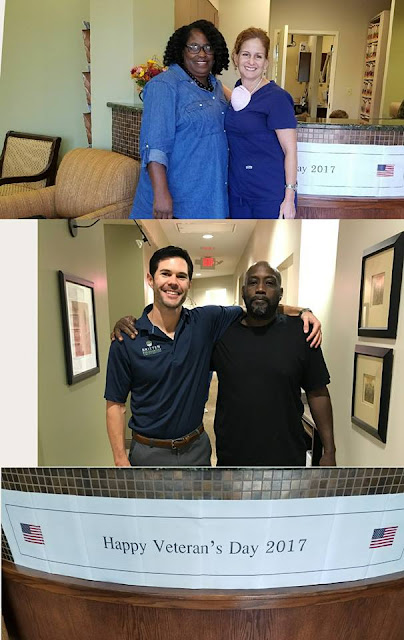


Dr. Britten’s dental specialty, periodontics, often involves managing and treating advanced gum disease. A periodontist is often able to help a patient in danger of losing teeth or with active oral infection to turn their health around. “Having Clearwater Dental Associates involved again this year, and the gracious help of Dr. Mike Podlusky and his team enables us to provide more comprehensive care to our veterans. Being a periodontist, my specialty is really the surrounding structures of the teeth; roots, gum and bone. My job is to help with the foundation. Having the restorative specialists involved helps us to treat the whole mouth and really deliver comprehensive care to these veterans.” Dr. Britten sees most patients for a comprehensive evaluation, radiographs and treatment consult prior to the event in order to determine what services he as the gum specialist can provide in his office, and make appropriate referral for restorative care from local dentists who have volunteered to help with the event.
Britten says being able to offer two different forms of sedation to Veterans for this event in his Clearwater, FL practice has helped for patients who have PTSD, dental anxiety, or may require extensive surgical treatment.  Dr. Britten expressed his concern. “Most of the time, periodontal disease is not painful until it gets to be very advanced. Some of the veterans had been dealing with painful teeth for a long time.”
For Britten and his team this event is something they look forward to all year long. They keep in touch with veterans from previous events and this year they were able to provide follow up exams, x-rays and periodontal maintenance procedures, which help prevent reinfection of the gums following treatment. “This year we were able to invite Veterans from previous events to receive follow up maintenance care at this year’s event,” said one dental hygienist at Britten Periodontics who helped organize this year’s event. "It was great to see them again and the progress they have made in their oral health. It is touching to be a part of something that has changed someone's life in such a positive way."
One patient returning this year received treatment at the inaugural event was John Smith, who served in the US Navy in Vietnam from 1965-1969. Dr. Britten explained that he was honored to be able to help Mr. Smith and to continue in his care since the 2015 event. The VFW Post 2473 in Clearwater where Mr. Smith serves as canteen manager does much to help local veterans.
When asked what this event meant to him in 2015, Smith had stated, "I get to keep my teeth and I can't believe it's free." A patient new to this year's event, Yvette said, "This was the most amazing dental cleaning I have had in my whole life!"
Dr. Todd Britten explained how glad he is to be doing this the third year in a row and would like to do it annually for the entirety of his career. When asked why this is a cause so near and dear to his heart he stated that his grandfathers and uncles served in the military and giving back to veterans in need is a top priority for him. Dr. Britten said, “The entire staff at Britten Periodontics is so grateful to the men and women in the military that make so many sacrifices for our freedom.”

Britten Periodontics & Implant Dentistry is a periodontal practice offering patients personalized dental care in implant dentistry in Clearwater, Florida. Dr. Todd Britten received his Bachelor of Science & Doctorate of Dental Surgery from University of Florida, a Master’s Degree and Certificate in Periodontology and Implant Dentistry; and completed extensive training at the Institute of Advanced Laser Dentistry. He is one of the only board-certified periodontists in Pinellas County. He is a member of the American Academy of Periodontology, American Dental Association, Florida Association of Periodontists, Upper Pinellas County Dental Association, Hillsborough County Dental Association, Hillsborough County Dental Research Association and Florida West Coast Dental Association.

www.brittenperio.com


Tuesday, July 25, 2017

Clearwater FL Periodontist Dr. Todd Britten discusses importance of Periodontal Maintenance


If you've undergone treatment for periodontal (gum) disease, you know how involved it can be, whether your treatment required nonsurgical therapy, surgical therapy or a combination of both.

Following gum surgery or scaling and root planing, a nonsurgical periodontal therapy, plaque and calculus (hardened plaque deposits) are removed and as they heal swollen, red gums finally begin to regain their healthy pink color.

Treatment does not stop there. If it does, there's a high chance of a re-infection of the gums.

Periodontal maintenance (PM) is important for gum disease patients after treatment. Plaque, a thin film of bacteria and food particles responsible gum disease, continue to grow again on your tooth surfaces as it did before. Diligent, daily brushing and flossing to curb that development.

It is also important to keep up regular dental visits for advanced cleaning to remove hard to reach plaque and calculus. For gum disease patients it is usually four but for some advanced gum disease patients, six times a year, especially just after treatment. Many of our patients alternate visits for periodontal maintenance between our office and their general dentist so that their periodontal condition is closely monitored, as well as the health of their teeth.

Our goal is to reduce the chances of re-infection. To do this, we'll thoroughly examine your teeth, gums and any implants for signs of disease (as well as an oral cancer screening). This includes an assessment the health of your teeth and gums and to see how well you're doing with plaque control and review your recommended customized daily oral hygiene instructions.

Overall, we want to prevent the occurrence of any future disease and treat it as soon as possible if it relapses. Keeping up with homemade and a routine periodontal maintenance schedule will help ensure your gums continue to stay healthy.

If you would like more information on periodontal disease, please contact us or schedule an appointment for a consultation 727-586-2681 or visit our website at www.brittenperio.com

Sunday, March 5, 2017

Clearwater Periodontist Shares What is Oral Lichen Planus


If you’ve noticed a small sore in your mouth, it’s possible you have a non-contagious disease known as lichen planus. Although usually benign, it’s still a good idea to have it examined and monitored.

 The condition is so named because its lesions are similar in appearance to lichen, the algae and fungi organism often found on rocks and trees. It’s believed to be a type of autoimmune disease, in which the body treats some of its own cells as foreign and reacts adversely to them. Certain medications and substances may also cause a lichenoid reaction. Besides the inner cheeks, gums or tongue, lichen planus may also appear on other skin or mucous surfaces on the wrists, legs or fingernails.

When it appears inside the mouth it usually resembles a lacy pattern of white lines or ulceration. Gum tissues may become red and inflamed, with some soreness after brushing or eating. Although there’s no known cure for lichen planus, it rarely causes serious problems — in fact, you may not even be aware you have the condition unless pointed out during a dental exam. It may, in time, fade away.

If the lesions do become bothersome (painful, itchy or overly-sensitive), there are some ways to ease discomfort: brushing with a soft toothbrush (to minimize irritation), flossing, and avoiding acidic or spicy foods and beverages which have been known to cause flare-ups. Managing stress is also helpful, and a topical steroid may be prescribed for more severe outbreaks.

Perhaps the greatest concern with lichen planus, though, is it may resemble more serious conditions, particularly oral cancer. The only way to be certain that it is a benign condition is to perform a biopsy on some of the affected tissue. If you notice a problem, be sure to visit us for a complete examination. And regardless of whether you have the condition or not, regular oral cancer screenings, as well as limits on alcohol consumption and stopping use of tobacco, will also reduce your risk of oral cancer.

Odds are if you have a case of lichen planus it isn’t causing you any problems. If it does cause you discomfort, though, you can take steps to ease your symptoms.

If you would like more information on lichen planus and similar oral conditions, please contact us or schedule an appointment for a consultation. www.brittenperio.com


Tuesday, October 4, 2016

Clearwater FL Periodontist Dr. Todd Britten Shares: Clenching and Grinding of Teeth, contributes to periodontal disease

Over 60 million Americans grind their teeth at night


Do you ever wake up with an aching jaw, tooth sensitivity or notice that your teeth seem to be shifting or loosening? Clenching or grinding your teeth can put excessive force on the supporting tissues of the teeth and could speed up the rate at which periodontal tissues are destroyed. Teeth grinding or clenching can also cause abnormal wear and tear on the teeth which will prematurely age and loosen them, causing problems such as hypersensitivity (from the small cracks that form, exposing your dentin). Clenching or grinding, known as bruxism, can also lead to chronic jaw and facial pain, as well as headaches.
If no one has told you that you grind your teeth, here are a few clues that you may suffer from bruxism:
Your jaw is sore often, or you hear popping sounds when you open and close your mouth.
Your teeth look short or worn down.
You notice dents in your tongue, especially along the edges.
A common therapy involves use of a special appliance worn while sleeping which your dentist can custom fit for you.
Dr. Britten can evaluate you for evidence of clenching or grinding and make the appropriate recommendation to avoid further damage to your teeth, gums and TMJ.

If you have any questions or concerns about bruxism, please contact our office at 727-586-2681 or visit our website at www.brittenperio.com.  

Tuesday, August 23, 2016

Clearwater FL Periodontist Todd Britten Shares: What is Periodontal Disease?

What is periodontal disease?


Q: What is periodontal disease?
A: Periodontal disease, also known as gum disease, often begins as a buildup of plaque on the tooth's surface near the gum line. If this plaque is not removed by brushing and flossing regularly, it can harden into what your dentist calls tartar. Plaque will continue to build up over the tartar, eventually causing the gums to become red, swollen, and irritated. This is known as gingivitis and is the first stage of periodontal disease. If leftuntreated, gingivitis can turn into periodontal disease.
What are the symptoms of periodontal disease?
-Red, swollen, sore gums
-Gums that bleed when brushing and flossing
-Teeth that appear longer or become loose
-Large spaces that form between the teeth
-Gums that begin to pull away from the teeth
-Chronic bad breath
Periodontal disease, if left untreated, can contribute to other health problems including heart disease and diabetes. If you're pregnant, having periodontal disease is also linked to premature birth or low birth weight. Your smile's health affects the overall health of your body.
As a periodontist, Dr Britten enjoys making a positive impact in our patients’ lives by improving their smiles as well as their comfort and health. We believe in delivering state of the art care with a gentle touch in a lighthearted environment. If you have any questions about your periodontal (gum) health, please contact our office at 727-586-2681 or visit our website at www.brittenperio.com.

Tuesday, July 19, 2016

Clearwater Periodontist Dr. Todd Britten: Periodontal Disease Can Be Treated and Controlled

Periodontal Disease Can Be Controlled and Treated

Periodontal Disease Can Be Controlled and Treated

Your dentist and/or dental hygienist routinely perform an examination of your gum tissue health which includes periodontal probing, or measuring of the depth of your gums.
Unhealthy gums pull away from the teeth and form "pockets" that are infected. The body's immune system fights bacteria as the plaque spreads and grows below the gum line. Bacterial toxins and the body's own enzymes fighting the infection start to break down the bone and connective tissue that hold teeth in place. If not treated, the bones, gums, and connective tissue that support the teeth are destroyed. The teeth may eventually become loose and have to be removed.
Periodontal disease – and the harmful affects to the gums and supporting structures of the teeth – can be controlled and treated. Improvement to our patients’ overall health is also often dramatically improved.
The health improvement is easy to appreciate when you consider living with an active bacterial infection, easily exposed to one’s bloodstream, can have a detrimental affect beyond the harm to the tooth and gums.
If you have symptoms of gum disease, contact us immediately. Gum disease addressed early can be reversed – and gum disease addressed later can be controlled. For more information, please contact our office at 727-586-2681 or www.brittenperio.com.